Monday, 21 August 2017

filmbore picks Wild Tales

Wild Tales

Director: Damián Szifron

Screenplay: Damián Szifron
Starring: Erica Rivas, Ricardo Darin, Leonardo Sbaraglia
Year: 2014
Language: Spanish
UK rental release: June 2015

IMDb
Rotten Tomatoes


The hiatus is over!

It's time for filmbore to reemerge from hibernation and return to the fold. It's been a crazy year and a half, with many events and goings-on, the finale of which was marrying the most beautiful, intelligent and hilarious person in the world...Mrs.filmbore!

Therefore, it's relevant that I talk about a wedding movie, such as the Oscar nominated Wild Tales. And who knows...maybe I'll experience a few things I missed in my own adventure into wedlock...

Welcomed by a low shot of a rushing airline passenger, we're invited to join them on an exciting journey. Famous model, Isabel (Maria Marull, Before Opening Night, Primavera), is unaware of the flirting charm about to be bestowed on her by her neighbouring passenger, classic music critic Salgado (Dario Grandinetti, Talk To Her, The Dark Side Of The Heart).

After some coquettish chat, something peculiar happens; another passenger overhears the mention of a mutual acquaintance. When the three of them discuss this, another traveller realises that they have the same connection. This continues, starting a chain reaction through the whole plane. How can they all be connected by just one man? Is the flight a ruse, with a deeper meaning at hand?

But this is just the first story in this compendium of revenge, as further tales of tension await us.  Like the waitress, startled by appearance of a demon from her past. The pain he has caused her family beyond humane, he now sits in her restaurant, unaware of her vengeful presence.

Or Diego (Leonardo Sbaraglia, Intacto, Burnt Money), cursing a reckless driver intentionally setting out to annoy him. He speeds ahead to leave the scoundrel in his wake, only to suffer the bad luck of a flat tire shortly after, fearful for the reappearance of his antagonist. Inevitably turning up shortly after, this tarmac tyrant proceeds to attack Diego's vehicle. Will he attack him next? Does Diego escape or does he retaliate?

Then we have Simón (Ricardo Darin, The Secret In Their Eyes, Nine Queens), an explosion specialist on his way to pick up his daughter's birthday cake. Alarmed at the price of the cake, he's even more startled that to find his car has towed away. Now running late for his kid's party, met with obstacle upon obstacle, he becomes convinced that the 'system' is against him as events escalate; his own inner explosions to a self generating conspiracy.

Or even our unforgettable finale, which opens with jubilation at the entrance of our bride and groom. Romina (Erica Rivas, Incident Light, Lock Charmer) sees her new husband chatting to a mystery lady. They seem a little too close. She begins to suspect unfair play. How should she deal with this on her special day?

As our six protagonists are left to deal with their circumstances, we lay waiting to see how wild they should truly go.


Before watching a film, I try to avoid any plot lines, like the ones you see on the back of DVD covers. They can implant preconceptions that can affect viewing. After reading the above synopsis you may have realised that this is not solely about a wedding. Only one of the stories is. It dawned on me at about 20 minutes that the wedding shown on the front cover of the DVD was just a small part of this entire story. So much for my plan on avoiding the plot here then!

The marriage-factor may be the reason I chose this feature but, even though this isn't the focus, I'm not disappointed at all. The entire picture is a constant stream of canapés, subtly satisfying your appetite through it's well balanced journey. It's no wonder it picked up the gongs that it did (including BAFTA's and Goya's). It was optioned for the Palme d'Or at Cannes too, where it debuted, helping the feature garner some well deserved attention.

The beginning of this adventure, 'Pasternak', demonstrates a different kind of attention. After a young gentleman ogles over our model, Isobel, much to her discomfort, it is in fact the older gentleman she meets next who flirts with more success. By showing here that it's not age that's attractive but charm and sophistication, this creative picture immediately grounds itself in reality. It's a smart move that few films manage to do so delicately and simply.

Such wit and allure can only be carried by a cast that has the talent to bear it, and it's in these performances that Wild Tales really shines. All players involved are truly superb. In fact, it's quite difficult to pinpoint specific performances with so many involved. They are all truly outstanding. You're likely draw out your own favourites, dependant on your taste. If I had to select my standouts: Oscar Martinez (Empty Nest, The Distinguished Citizen) in 'The Deal' really moved me, as did Julieta Zylberberg (The Tenth Man, The Invisible Eye) in 'The Rats'. The most exciting performers, however, have to be both Ricardo Darin in 'Bombita', and the unforgettable Erica Rivas in 'Til Death Do Us Part'.

This latter chapter is welcomed and much needed after some of the gloom, deftly delivered in the previous acts. There are small nuggets of humour and lightness strewn throughout the whole picture, even if these morsels struggle to hold ground amongst all of the drama. This is a movie that knows when to take itself seriously and it doesn't falter in getting your attention while doing so. Yet, this wedding based finale re-balances the gravitas of the previous vignettes while still retaining the level of darkness required to justify it's existence in this compendium.

To be honest though, this is not a true portmanteau movie. Each vignette could stand alone as a short, and maybe this was purposeful. Nevertheless, while fantastic, all the tales don't operate as a whole. They seem a little disconnected. Disjointed, even. You may be wondering what the link between the segments is. You may start out, as I did, thinking there's a connection about travelling, until you realise that it's not.

It's just as difficult to pin down it's thematic approach. There's a chance that I just missed it. I played with a number of ideas, including unpredictability, antagonism fuelling revenge (too obvious!), even the detrimental outcomes of making the darker choice. None really fit though. If the core themes were more recognisable, I feel they would help solve the issue of the picture's connectivity and making it a proper portmanteau flick instead of a fortunate compilation.

A benefit of taking this approach does allows for a plethora of different filming styles though. We're presented with a noir, a thriller, a car chase and many more. It brings a wonderment of variety and floods of creative filming and editing techniques; you'll forget that this was made by one director. 

Cinematographer, Javier Julia, takes advantage of this, dressing the picture with all manner of angles, while allowing hints of the unconventional. Take the opening cowboy shot of Isabel running through the airport, or the claustrophobic shots in the car chase of the third tale, 'Road To Hell' to marry up with your usual collection of POV's and low angle shots. With experimental shooting and some delicious framing, it's a visually brave film.

All of these methods deliver some delicious imagery; a hand clasped across a lady's face, gripped for abuse, slowly withers as her attacker perishes, embracing the victim in his own blood. The camera pans up to an aerial shot of our two victims, lying in the wake of their battle, fixed in posture like silhouetted dancers. It's a strangely pretty film, finding beauty even within its more darker edges.

It doesn't hold its punches either. Take the in-car fight scene in 'The Road To Hell': it may not have the level of choreography but it's got enough gusto to challenge the now infamous car scene most will have seen last year in Deadpool (2016). It's nowhere near as clipped as it's Marvel counterpart, but it's just as funny, end even more claustrophobic and brutal! 

Not afraid to show some 'claret'  and ferocity when necessary, Wild Tales is full of surprises, and heavy ones too. It drags you through its rough-and-ready journey but not reluctantly. It teases your intrigue, enticing you to join the ride. Just be prepared...this road's a little bumpy!


So, did I find anything new that could have improved my wedding? Did it garner any life lessons to take on my own adventure of marriage? Absolutely not. The wedding in this is an absolute shambles!

Thankfully though, the film isn't. Yes, the tales do feel a little disparate to each other but they certainly live up to the garb of 'Wild'. Each story is eloquently crafted, deserving award and praise in their own right. We're just fortunate enough to get to see all of these wonderful pieces in one gloriously delivered whole.


Don't forget to leave comments below, tweet me @filmbore or post on my Facebook page here. 

Alternatively, you could contact me directly about this film or my other reviews on picks@filmbore.co.uk

Thursday, 5 November 2015

filmbore picks Two Days, One Night

Two Days, One Night

Director: Jean-Pierre Dardenne, Luc Dardenne
Screenplay: Jean-Pierre Dardenne, Luc Dardenne
Starring: Marion Cotillard, Fabrizio Rongione, Catherine Salée, Christelle Cornil
Year: 2014
Language: French, Arabic
UK rental release: October 2014

IMDb
Rotten Tomatoes

This time around, we're paying a visit to the Dardenne brothers once again. For years, they've continued to deliver stunning, intimate dramas (for their beautiful pastiche of childhood rebellion, check out my review of The Kid With A Bike).  Yet, with Two Days, One Night, they're taking a slightly different approach...

While resting, Sandra (Marion Cotillard, La Vie En Rose, Rust And Bone) is awoken by an alarming phone call. She finds out that her job is on the line due to a secret ballot taken up by each of her colleagues at her place of work: either they all take a bonus of €1000 with Sandra being laid off, or they choose to keep Sandra on but loose that tempting cash prize in doing so.

Sandra has been off sick for a while with depression and anxiety. Her absence has put her in the firing line and allowed the ballot to occur. Immediately, she is worried that she'll begin to suffer again as a product of this surprising election.

She tries to stay strong with help from her partner, Manu (Fabrizio Rongione, Rosetta, L'enfant), who strives to support her, reminding her that she has a right to fight for her position. She goes to see her boss, M. Dumont with one of her colleagues, Juliette (Catherine Salée, Keeper, Blue Is The Warmest Colour). As one of her only workmates who voted for her to stay, Juliette wants to do everything she can to help.

From speaking to M. Dumont, they learn that their foreman, Jean-Marc, has been leveraging the votes. Scaring staff members into electing for bonuses, he's been telling them that they could lose their job soon anyway so may as well take their bonuses. His effort makes the election sway 14 out of 16, in favour of Sandra losing her job. In light of this, and the knowledge that Sandra wasn't present at the ballot, M. Dumont agrees to a re-election.

Having only till Monday to succeed, Sandra must use her weekend to convince her work colleagues that her worth is more vital than their wallets.


Naturally lit through most of it, with lovely handheld lens work, Two Days, One Night is pleasant on the eye. Unusually for the Dardennes, there's very little on scenery and more focus on close-ups, making the picture feel a little claustrophobic. However, if you can see past this, appreciating the intimacy of the people as opposed to the environment that surrounds them, you'll sense how this emphasises the core plot and drive of the film. 

For example, during a brief reprieve from their many visits our two leads sit in a park, enjoying an ice cream, discussing whether to continue on this saga. Hearing a bird's song, Sandra says "I wish that was me". In previous Dardenne movies, the camera would have mainly shot the bird, with Cotillard's dialogue off camera, sun shining through the tree, illuminating the leaves, illustrating an artistic eye. 

Instead, the lens stays fixed on the pair, as Sandra longingly glares off camera at the easier life. Simplistic. Direct. Gently impactful. It's a template for the entire piece and the effect is gentle yet stunning.

Her reaction during this scene is a product of Sandra's evolution through the story so far, learning more and more each time she's faced with confronting a fellow employee, as she both strengthens and crumbles through the experience. This is beautifully encompassed by Marion Cotillard, as she proves yet again that she is one of the finest actresses of our generation (read about her stunning performance in Rust And Bone here).

Little-or-no make-up, vest tops, tied back hair - still with such a simple costume, Cotillard proves her talent by delivering a performance with colour, turmoil, panache and vibrancy. Once more, she elevates a film with her subtle and dexterous approach to a role of a troubled, interesting soul. Such a character would have been saturated with cliché by many others, heavily handled with little regard for realism, where Cotillard handles Sandra with careful finger tips from a thoughtful veranda.

And, with confident execution from the array of actors to bolster her delicate portrayal, it allows us to peer into the world that suffocates Sandra. What this piece manages brilliantly is bring new insight into how somebody under sever pressure, with familial responsibilities, has to manage the feud between their pride and their integrity.


At first, Sandra is both loathed and embarrassed to beg a colleague for their vote. Yet, how she handles this plight, struggling through the experience, is a tenderly presented view into the emotional strengthening someone goes through while battling the remnants of mental illness. Her anxiety and depression is represented tastefully, respectfully; so pleasing considering such subject matter is generally misunderstood in most cinematic sittings.

It has the desired effect, raising questions as to whether she is fit enough to return to work. It also makes you question what it is that Jean-Marc is up to. The mystery of her foreman's "treachery" (although not entirely revealed) is a nice MacGuffin, yet it's not that which drives the film...


How do you ask somebody to give up their gift of €1000? It's an intriguing prospect for a movie and, as you see Sandra's journey unfold through each moment, the alternate reactions from each of her colleagues will take you in all different emotional directions.

For example, if someone desperately needs their bonus through their own despair, they're left to feel uncomfortable when learning that others are siding with Sandra. Their sympathy is empty as, if the vote goes in her favour, they lose the cash that they so rightfully need, in some cases. Out of respect they feel that they cannot show their disdain. Some even happily give the address for the next person on her list, even though this gives her the opportunity to canvass more voters.

Even if they raise the chance of swaying the votes back, how can they not help someone else who has needs like themselves. Such confliction between what's right to survive and what's humane is what illuminates the picture. Watching each meeting is so gripping, purely in the underlying complexity of the conversation. It's a fantastically simple mechanism for each actor to play with on screen. 

Wondering whether she'll plant enough seeds to keep her job fuels your desire to see each outcome, enhancing the calm pace of the film to one of intrigue and allure. It proves the genius of the overall concept and of the Dardennes. 

The brothers strike again!


A wonderful portrayal of family and friends clubbing together to support one of their tribe, Two Days, One Night does wonders at handling the struggle of overcoming anxiety and depression. It's such an incredibly tense and moving tale set over a relatively short period of time. Yet, it's the originality of the concept that thrives in this touching and reinforcing tale.


Don't forget to leave comments below, tweet me @filmbore or post on my Facebook page here. 

Alternatively, you could contact me directly about this film or my other reviews on picks@filmbore.co.uk

Wednesday, 19 August 2015

filmbore picks Leviathan

Leviathan

Director: Andrey Zvyagintsev
Screenplay: Oleg Negin, Andrey Zvyagintsev
Starring: Aleksey Serebryakov, Elena Lyadova, Vladimir Vdovichenkov, Roman Madyanov, Anna Ukolova, Aleksey Rozin, Sergey Pokhodaev
Year: 2014
Language: Russian
UK rental release: March 2015

IMDb
Rotten Tomatoes

Nominated for Best Foreign Film at the 87th Academy Awards, Leviathan just lost out to Pawel Pawlikowski's Ida. Before this, however, this didn't stop the movie picking up gongs at the London Film Festival Awards, the Golden Globes and getting Best Screenplay at Cannes Film Festival. It turned up at the Oscars as some pretty tough competition. Let's find out why...

Nikolay (Aleksey Serebryakov, Cargo 200, PiraMMMida) is a self made man, living off the land and running his own car repair shop. A tumultuous, if hard-working father, he's currently in the middle of a huge turning point in his life. At the tail end of some of this turmoil is Nikolay's temperamental son, Romka (Sergey Pokhodaev, Six Degrees of Celebration). 

Nikolay and Romka are clearly close, which maybe how some of the father's angst has rubbed off on the son, yet something else is affecting the boy. Nikolay's patient, strong wife Lilya (Elena Lyadova, The Geographer Drank His Globe Away, Elena) is not Romka's natural mother, a fact that the young man wears openly. Their relationship is very strained. All of this is having huge impact on Lilya, clearly making her feel remote. 

There is small respite through her mild friendship with fellow workmate Anzhela (Anna Ukolova, The Edge) yet this isn't enough to sate the remoteness she is starting to feel.

Nikolay picks up his brother, Dmitriy (Vladimir Vdovichenkov, Paragraph 78, Reketir) from the train station. A lawyer, Dmitriy is visiting to help Nikolay with his recent plight. Nikolay has a court hearing following his involvement with the local council. They want to seize some of his land for mysterious reasons. Appeals made, following loss of business income and more, fall by the wayside and are declined. His hearing does not go well.

The town mayor, Vadim (Roman Madyanov, Hopelessly Lost, Wild Field), is the man pushing for the seizure of the land. There's definitely something underhand going on, with visits by the city's priest a regular occurrence. On the evening after the hearing, Vadim has the bright idea, through his drunken state, to pay Nikolay a visit and remind him of his claim.  

Vadim's tense visit could be his undoing, as it gives Dmitriy extra ammunition to use in his fight through the courts. Our lawyer has more than just a statement on Vadim's tempestuous, intrusive manner, however... he has a book full of nasty deeds on the manipulative mayor! Will it be enough to get Nikolay and his family what they deserve?


Even before it's release, Leviathan was already causing some upset. Not only has it caused controversy from a religious perspective, both in its jaunted view of the Russian Orthodox Church and similarities to the story of Job, but it has caused even further upset through the suggestion that it is purposefully attempting to undermine the country's leader, Vladimir Putin. Being at a delicate time in Russia's current climate, this has led to much online berating and articles extensively digging through the intention of the story to incite political uproar, judging the tale's moral connotations and stereotypes of drunk Russians. 

In response to these outcries, director Andrey Zvyaginstev stated...
“The story is completely universal, not just in a special geographical context but in the sense of time. It’s not about a concrete era...It just so happens that the era in which we filmed it bears a little bit too much resemblance to [current events].”
...and there it is. So, with that in mind, I'm not going to entertain any furore over the supposed negative impact that a fictional tale has during its unfortunately timed release. Instead, I'm going to try and focus on the film, its story, characters, performances and quality, with maybe a little bit of metaphoric thematic analysis thrown in along the way.

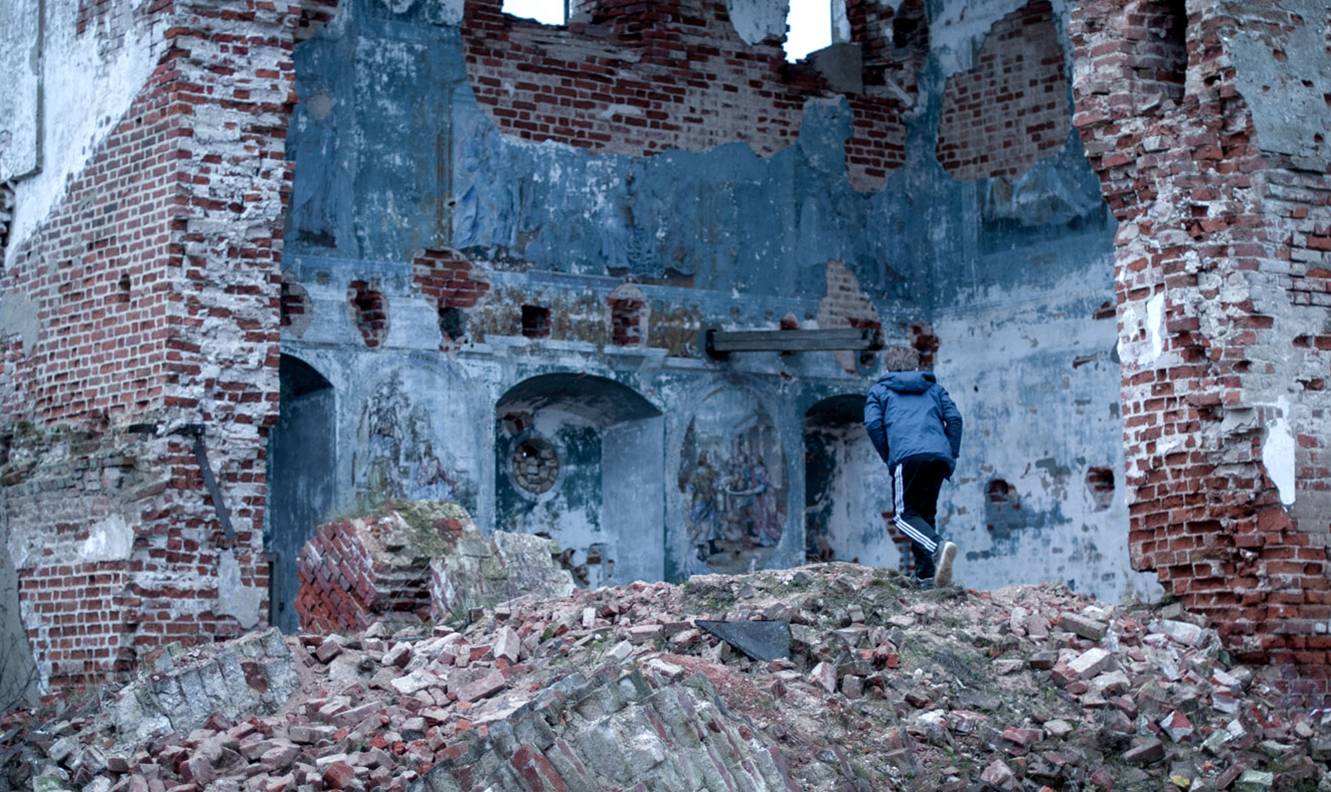
A dulled beauty is apparent as soon as the piece emerges, with opening shots of the stark coastal landscape setting the tone; a voice we are reminded of when the opening orchestral score stops abruptly during images of shipwrecks. It really doesn't take long to notice that this is a moody looking picture, with plenty of shots of barren, yet beautiful, landscapes, strewn with derelict buildings doused with damp and frescoes.  

Shot at all times of day, it's the scenes filmed at dawn and dusk that carry the most weight, accenting the beautifully bleak look that the film delivers. Even though such lens work doesn't get to take much advantage of the high definition shooting, which further highlights the tone and sense the story is trying to portray, this doesn't deter from the feel of the picture overall.

Shots are held for plenty of time for each actor to elicit responses to their counterparts; lingering long enough to catch a facial twitch, or a gentle double-take. It's a confident angle to take in such a delicately paced drama, yet it works so well. This approach helps to emphasise the strain and earthiness that brews within the performances, each character subtly playing off each other for required absolution and refutes.

The biggest victim of these manipulations is the man amidst the hurricane, Nikolay. His journey is quite tough to absorb, as he is pulled in all directions by those that need him, those that repel him and his own inner-self's need for nostalgic legacy and justified stubbornness. 

It's heart-wrenching seeing a man being pushed to his limits, even if necessary to ensure that the story pertains to what it beholds. Be prepared for some heavy themes and startling outcomes. It's quite ominous in parts, but it has to be; a weight that feels fundamental in this piece's invite through the window of a small, if powerful, town, burgeoning with hunger from its turbulent mentality and egocentric inhabitants.

Besides the depth in the plot, it's the performances of these driven characters that hold the entire piece together. The late night confrontation between Nikolay, Dmitriy and Vadim is a showcase for some of the best drunken-acting I've ever seen. It's not too over-the-top or cliche, but subtle enough to seem genuine, while volatile enough to garner tension slowly, all the while seeing how their behaviour is wholly inappropriate; their reaction unnecessarily accentuated. Unusually, there are also minor touch-points of humour. Clearly intentional, if substantially light, they are mere flashes amongst the stirring drama, yet as just as important an ingredient in forming the personality of the piece.

All our actors handle this unconventional blend comfortably, each running away with each scene with little care of the viewer, gracing the piece with a natural tone. One performer who manages this well is Anna Ukolova. She's not starred in many films but she has a great acting presence. I feel she deserves more exposure in the film industry, as she has natural talent in front of the lens. She could be real rising star out of this film.  

Of all the actors though, the one who towers above them all is Madyanov as the poisonous mayor, Vadim. One part classic villain, on part modern pawn, all wrapped up in the saturated skin of a drunken control freak, he's the outlaw that needs ousting by the hot-shot lawyer. Madyanov embodies this charismatic power-monger with sincerity and aplomb.

Drunk from power and vodka, the mayor cuts a demanding presence and it's truly a shame that there wasn't more screen time for him. I could quite happily watch a film purely on Vadim.  

It's the strength in these characters, along with their complex chemistry, which tear me away from the obvious 'Book of Job' comparisons (impending house demolition equals Job's hurricane;  peering up to circular images equals questioning God for the perpetual despair, etc.), instead propelling me to liken it to a different type of movie altogether...


Picture the scene: Dmitriy is the loner in an old, familiar town. He's been invited to save the town by Nikolay, the drunk saloon owner, who is struggling to overcome the megalomaniac sheriff, Vadim. Wanting to own the the last piece of the pie, this regularly inebriated abuser of the law will stop at anything to overthrow Nikolay and take the bar as his own. Can the wandering hero Dmitriy stop this crazed marshall before it's too late?

Leviathan has wrongly been accused as a portrayal of stereotypes in the need for political-grooming. Yet, it is clearly more a literal 'Western' than trying to just cater for western palates, which is a far more international genre anyway, especially with its heritage in Japan's 'Chanbara' movies. That's a far romantic comparison, don't you think?


Admittedly, there is a bit of a dip in pace throughout the third quarter of the film, which says a lot when considering that it is actually fairly slow-paced. Stick with it though, as it is still a brilliantly rewarding piece. It may been seen as brave in its subject material, especially in the face of all of the controversy, however nothing can prepare for startling climax. A great example of ignoring the negative and listening to the real!


Don't forget to leave comments below, tweet me @filmbore or post on my Facebook page here. 

Alternatively, you could contact me directly about this film or my other reviews on picks@filmbore.co.uk

Wednesday, 20 May 2015

filmbore picks The Past

The Past

Director: Asghar Farhadi
Screenplay: Asghar Farhadi
Starring: Bérénice Bejo, Ali Mosaffa, Tahar Rahim, Pauline Burlet
Year: 2013
Languages: French/Persian 
UK rental release: June 2014

IMDb
Rotten Tomatoes


In the UK, there have been two forces dominating the news of late: Family, through the royal baby, and Politics, via the General Election. Merging both, let's delve into the gentle turmoil of 'family politics' with Asghar Farhadi's, The Past. 

Marie, (Bérénice Bejo, The Artist, Populaire) waits patiently at the airport terminal for her expected visitor. Her ex-partner, Ahmad (Ali Mosaffa, Leila, The Last Step) arrives, having flown in from Iran, bringing with him some luggage issues. Clearly, these two have known each other for a long time. The instant rapport allows Ahmad to forget about his missing suitcase for a moment.  

He can't help being cheeky. She can't help being amused by it. The old connections are still there, if only skin deep. Yet, something not yet spoken haunts their ease and natural chemistry.

Even though married for some years, they are about to finalise their divorce. Since the separation, Ahmad has begun to feel estranged from Marie's two daughters, Lucie and Léa (newcomer Jeanne Justin). While not being their biological dad, Ahmad has played an important part in their lives, with his living abroad obviously playing a part in the segregation now felt. 

While parked near the girl's school, Marie inside looking for Lucie, a traffic warden forces Ahmad to move the car. Circling the block, he chances upon the identification papers of a man named Samir, and starts putting things together.

Samir (Tahar Rahim, A Prophet, Grand Central) is Marie's new partner, living at her home with son, Fouad (also newcomer Elyes Aguis). A fiery boy, Fouad is displeased with having to move into Marie's, worsened now there's a "strange man" around. And, the longer Ahmad stays, the more he learns about the situation, discovering that Samir's ex-wife has been in a coma for months. 

He's still unsure of the full cause of her condition though, but not for long. Eldest daughter, Lucie (Pauline Burlet, La Vie En Rose, Dead Man Talking) has hit rebellious teens, causing strife and rarely sleeping at home, yet something else appears to trouble her. Ahmad has always had a good connection with Lucie, so Marie trusts him to speak to her in the hope that he might understand her behaviour.  

As he digs further, uncovering the source of Lucie's upset, he'll unravel the mystery surrounding Samir's ex-wife's coma.


A Memento Films production, Le Passé is an expertly produced drama. This is no surprise with Farhadi at the helm (click here to see my review of his touching masterpiece, the multi-award winning A Separation) as he delicately positions each element with deft care and relaxed precision. 

It flows at a serene pace, enhanced with some playful scenes to help reveal the overall piece's "real" feel. Keeping the amount of locations to a minimum, Farhadi enriches the film's native claustrophobia, birthed from the story's concept, and enhances that personal feel. This tight but strangely comfortable essence is a welcome extra ingredient of tension infused into the piece. 


Some of this is evident from the off, with the first encounter parading ease and edginess all at once. The director's arena has been justly built to house and reveal genuine performances from the cast; a task managed adeptly by the leads in particular. Calm, patient, with a subtle intensity, the most gentlest of gestures provided further purpose and weight for each character.

This approach is sorely needed for this piece. Even with the mystery underpinning the film, The Past isn't flaunting a complicated story. Until some of the later reveals, there isn't anything majorly complex at play, which is fine when considering the approach of the entire picture. This is about dialogue, normality and character. The open palette allows our performers to take grip of the brush themselves and take part in gracing the canvas with their own strokes of brilliance, creating a tangible body to clasp onto.

As equally palpable is the tense air between the two men, Tahar Rahim's casting adding an extra air of ounce of cool and brilliant. With gentle measure, the friction is lightly acrid, enough to be felt, but not over saturated as to spoil your palate. 

Airs of competitiveness start to appear, softly surfaced by our male leads. There's a particular scene in Marie's kitchen, where both sit in absolute silence; both too stubborn to break the air, while loosely awkward enough to be too scared to. Through mild mannerisms, the odd brief glance, hesitant reactions and nice pacing, it's raw and smooth all at once, both allowing the rivalry to brew while not fully embodying it. 

This is a smart approach, generating a genuine sense of inner disdain and naturally delivered etiquette, neither wanting to push the other too far in case they upset Bejo's character of Marie. Other actors may have easily embellished the conflict, which seems too obvious, yet, thankfully, these two opted for subtlety. And this film is all the better for it. 

The young cast hold their own against the adults too, especially Elyes Aguis as Fouad. He is just brilliantly cast. Being so expressive and sincere at his age, he has heaps of natural talent. In fact, all the actors, both young and old, permit a heartfelt requisite whatever the scene. It makes the film centre so attainable you'll slip into it with little effort. 

At it's core, however, sits one key performer. Bérénice Bejo is so self-assured and indomitable as Marie that she's the glue to the entire piece. Her delivery is delicious, switching from cool to combustible in a flash. Her whole performance is a masterclass on control, with her efforts just making enough room to add extra flavour to the relationship between her and her ex-husband, Ahmad. 

There's an air of true friendship between the pair. And it's the on-screen chemistry they exude that binds all of the other beautiful elements of this sweet and wonderful film together. Even through divorce, they find heart and softness in the most unlikeliest of places.


As gently paced as it is, you may need some patience of your own with The Past. It's so confident and calm it may appear underwhelming to some. However, if you hold out, you'll be rewarded with simple, moving tale of a complex, fervent family.


Don't forget to leave comments below, tweet me @filmbore or post on my Facebook page here. 

Alternatively, you could contact me directly about this film or my other reviews on picks@filmbore.co.uk